Latency Budgets for Chairside AI: Why Sub-Second Response Decides Whether Clinicians Use It
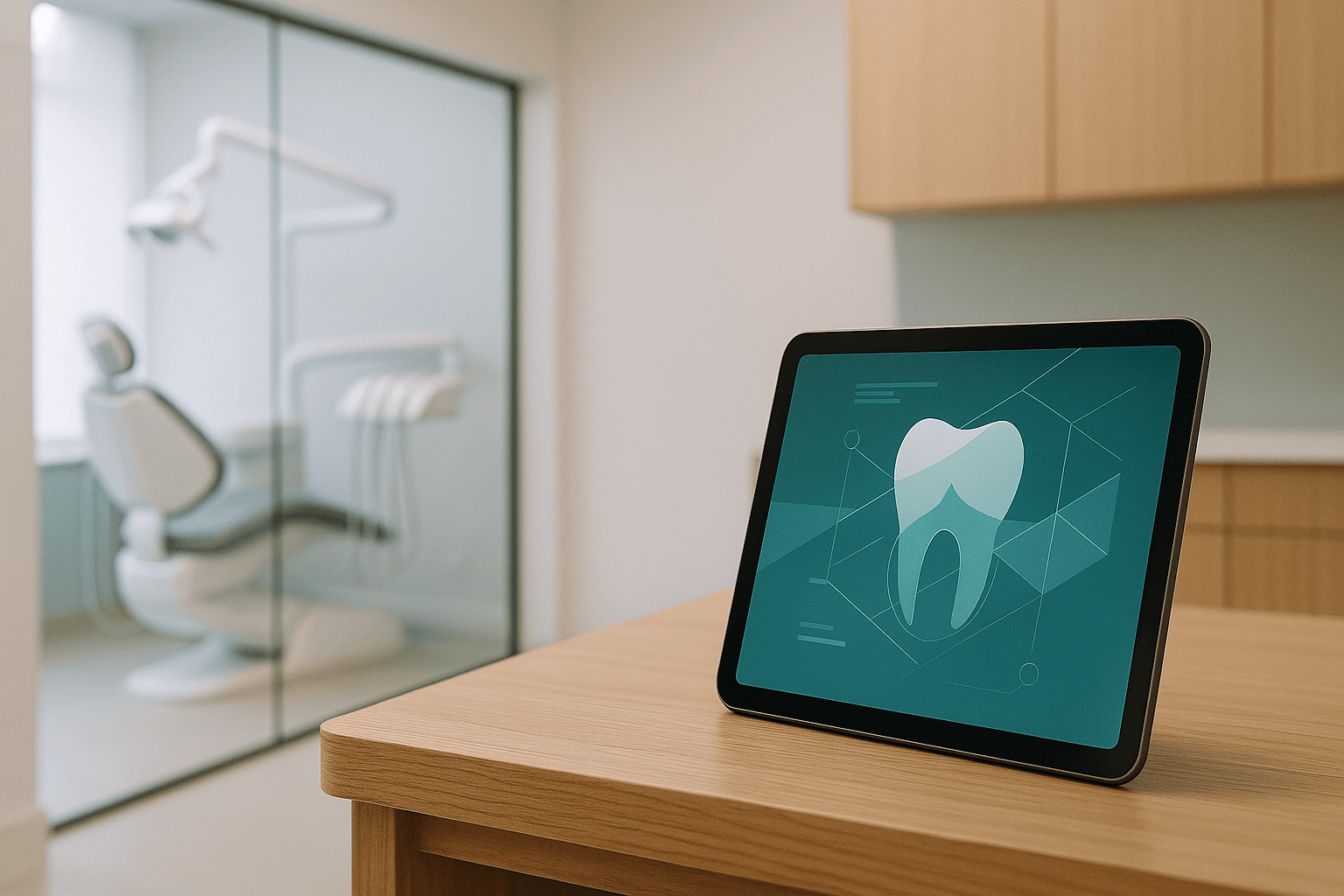
You probably think of chairside AI latency as a polish metric — shave a few hundred milliseconds, ship a smoother demo, move on. However, at the operatory chair, latency is not polish.
It is the single variable that decides whether a clinician reaches for the tool, or quietly routes around it for good. A clinical agent that stalls four seconds while the patient sits in the chair does not get a second chance.
Most teams arrive here the same way: they ship a clinical model that scores well in the lab and dies at the chair. We have too, which is why latency budgeting is now the first architecture conversation we have, not the last.
Why Four Seconds at the Chair Kills Adoption
The operatory runs on a tempo most software never has to respect. A clinician works in short bursts — gloved hands in the field, eyes on the patient, a fifteen-to-ninety-second window between procedure steps where a question can be asked and answered.
Four seconds of dead air does not read as 'loading.' It reads as 'the tool is broken,' and the clinician removes their hands, finishes the step manually, and stops asking.
Adoption is not lost in a procurement review or a board deck. It is lost in that four-second gap, one abandoned query at a time, until the agent is a line item nobody opens.
Chairside AI needs sub-second response because the operatory works in fifteen-to-ninety-second bursts between procedure steps. A clinician with gloved hands and a patient in the chair treats a four-second stall as a broken tool, removes their hands, and completes the task manually — abandoning the agent permanently after a few failed queries.
What Is a Latency Budget?
A latency budget is a fixed total response time, allocated across every stage of the request, that the system is engineered never to exceed. Instead of hoping the pipeline feels fast, you assign each component a millisecond allowance and hold it to that number in production.
For chairside work we budget against time-to-first-token, not time-to-completion. The clinician needs the response to begin streaming inside roughly 800 milliseconds — whatever arrives after that can keep flowing while they read.
A latency budget is a fixed end-to-end response time divided into per-stage millisecond allowances — network, retrieval, prompt assembly, inference, and tool calls — that the system is engineered never to exceed. For chairside AI the budget targets time-to-first-token, around 800ms, not full completion, because a streaming response that starts fast feels responsive.
Where the Milliseconds Actually Go
You cannot defend a budget you have not itemized. Below is a representative time-to-first-token breakdown for a chairside query held against an 800ms target.
| Stage | Typical cost | What drives it |
|---|---|---|
| Client to VPC network | 10–40 ms | PrivateLink path, TLS handshake, region proximity |
| Retrieval (vector search) | 50–150 ms | Index size, top-k, embedding cache hits |
| Prompt assembly + PHI redaction | 20–60 ms | Context length, KMS decrypt, template build |
| Model time-to-first-token | 200–600 ms | Model size, provisioned throughput, prompt length |
| Tool calls (charting, CDT lookup) | 50–200 ms each | Serialized round trips, downstream API latency |
The line that dominates is inference, and the line that hides is tool calls — because they serialize. Two sequential tool calls at 150ms each spend 300ms before the model has even resumed generating.
Why Chairside Is Harder Than the Back Office
An insurance verification job or an overnight note run can take eight seconds and nobody notices, because no human is waiting on a gloved hand. Chairside has no such slack — the human is the bottleneck-watcher, in real time, with a patient in front of them.
Back-office AI can also batch, retry generously, and absorb a cold start. Chairside cannot tolerate a single Lambda cold start of one to three seconds, because that one stall becomes the clinician's entire impression of the product.
This is why the same model that powers our clinical note summarization pipeline runs under a completely different latency contract when it sits at the chair. Same intelligence, different budget, different infrastructure underneath.
Chairside AI is harder than back-office AI because a clinician is waiting in real time with gloved hands and a patient present, leaving no slack for retries, batching, or cold starts. A back-office job like insurance verification can take eight seconds unnoticed; the same delay at the chair reads as a broken tool and ends adoption.
How We Engineer the Latency Budget
Budgeting is not one optimization — it is a stack of them, each defending a different line in the table above. Here is how we hold each stage to its allowance.
- Provisioned concurrency, never cold. Inference and orchestration run on warm capacity with provisioned throughput on Bedrock, so the clinician never pays the one-to-three-second cold-start tax that kills the first impression.
- Stream the first token, defer the rest. We budget against time-to-first-token and stream output, so the response visibly starts inside the window while longer reasoning continues to render.
- Cache the retrieval layer. Hot embeddings and frequent lookups sit in Redis in front of the vector store, turning a 150ms search into a sub-20ms cache hit for the queries clinicians actually repeat.
- Collapse serial tool calls. Where a query needs the chart and a CDT code, we fan those calls out in parallel instead of chaining them, reclaiming the serialized round trips.
- Pin the model version. Model-version pinning keeps inference latency predictable, so a silent provider-side swap cannot blow the budget overnight without us seeing it.
Retrieval design carries more of this load than teams expect, which is why we treat the vector database layer for clinical AI as a latency surface, not just a relevance surface. The embedding you cache is the round trip you do not pay for.
Time-to-First-Token Versus Time-to-Completion
These two numbers measure different things, and confusing them is the most common reason a 'fast' model still feels slow at the chair. Time-to-completion is when the full answer finishes; time-to-first-token is when the clinician sees evidence the system heard them.
Perception of speed tracks the first token far more than the last. A response that begins in 700ms and finishes in three seconds feels responsive; one that shows nothing for two seconds and then dumps the full answer feels broken, even if it technically completed faster.
Time-to-first-token measures when a response begins streaming; time-to-completion measures when it fully finishes. Perceived speed tracks the first token far more than the last — a reply that starts in 700ms and finishes in three seconds feels responsive, while one that shows nothing for two seconds then dumps everything feels broken.
What Breaks the Latency Budget in Production
A budget that passes in staging fails in production for reasons that have nothing to do with the model. These are the failure modes we instrument for from day one.
The four budget-killers we watch: cold starts on under-trafficked operatories, retrieval fan-out that grows with index size, serialized tool calls that compound under load, and silent provider-side model swaps that change inference latency without a deploy.
Each one is invisible in a demo and obvious in a P99. The fix is never 'use a faster model' — it is closing the specific gap the instrumentation exposes.
How We Prove the Budget Before a Clinician Sees It
A latency budget that only gets validated in production is validated on the clinician's trust, which is the one resource you cannot refund. We run new chairside agents in shadow mode first — serving real queries against real retrieval, measuring time-to-first-token at P95 and P99, with no clinician depending on the output yet.
Only when the tail latency holds under realistic operatory load does the agent move in front of a gloved hand. Shadow mode turns the four-second-stall failure into a dashboard line we fix quietly, instead of an abandonment we discover after the fact.
Why P50 Is a Lie at the Chair
A median latency of 600ms looks like a passing grade, but the median is the wrong number to manage chairside performance against. The clinician does not experience your P50 — they experience the query that stalled, and that query lives in the P95 and P99.
We hold budgets at P95 and P99, because a tool that is fast nine times and frozen on the tenth is remembered as a frozen tool. Tail latency is not an edge case at the chair; it is the case that decides adoption.
Measuring this honestly is the same discipline we bring to model quality, which is why latency lives in the same instrumentation as our clinical AI evaluation harness. You cannot defend what you do not measure at the tail.
P50 (median) latency hides the chairside failures that matter because clinicians experience the stalled query, not the average one — and stalls live in the P95 and P99. A tool that responds fast nine times and freezes on the tenth is remembered as frozen, so latency budgets must be held at the tail, not the median.
The Budget Cannot Be Bought by Cutting Compliance
The fastest way to win 60 milliseconds is to skip PHI redaction or decrypt outside the boundary — and it is the one optimization we will not make. Every stage in the budget, including the KMS decrypt and the redaction pass, runs inside the BAA-covered boundary, and the budget is engineered around that constraint, not in spite of it.
Sub-second response and HIPAA-grade handling are not a trade-off here; they are co-requirements. The way we keep both is covered in our deeper write-up on HIPAA-grade clinical AI for dental.
Frequently Asked Questions
What is a good latency target for chairside clinical AI?
Aim for time-to-first-token under roughly 800 milliseconds, measured at P95, not the median. The full response can finish later as long as it streams, but the clinician needs visible evidence the system heard them inside that window or the tool reads as broken.
Why measure time-to-first-token instead of total response time?
Because perceived speed tracks when a response starts, not when it finishes. A reply that begins streaming in 700ms and completes in three seconds feels fast, while one that shows nothing for two seconds and then dumps the full answer feels frozen.
What is the single biggest cause of chairside AI latency?
Model inference time-to-first-token usually dominates, but serialized tool calls are the cost that hides — two sequential lookups at 150ms each spend 300ms before generation resumes. Cold starts are the other silent killer on under-trafficked operatories.
Does keeping latency low force a weaker model?
No. Streaming, provisioned throughput, retrieval caching, and parallel tool calls let a capable model hit the budget without downgrading intelligence. The same model can run at a different latency contract chairside than it does in a back-office batch job.
Can you hit sub-second response without compromising HIPAA handling?
Yes — and it is non-negotiable here. PHI redaction and KMS decryption run inside the BAA-covered boundary and are budgeted for explicitly, so the latency target is engineered around compliance rather than achieved by cutting it.
Map Your Chairside Latency Budget
If you are scoping a clinical agent that has to live at the chair and want a second set of eyes on the latency architecture, the team at NexV builds and operates HIPAA-grade clinical AI across AI dental charting, note capture, and retrieval every week. Reach out for a working session — we will itemize your time-to-first-token budget, name the four failure modes you are about to hit in production, and leave you with a deployable plan that holds at P95.