AI Radiograph Analysis: How Computer Vision Is Changing Dental Diagnostics
AI Radiograph Analysis: How Computer Vision Is Changing Dental Diagnostics
For most of dentistry's history, interpreting a bitewing or periapical has been one of the most subjective steps in the clinical workflow. Two experienced dentists can look at the same radiograph and disagree on caries, furcation involvement, or the extent of bone loss.
Computer vision models trained on millions of labeled radiographs are changing that. They do not replace the clinician's judgment, but they dramatically raise the floor on what gets caught and how consistently.
This article walks through how AI radiograph analysis actually works under the hood, what the published evidence shows, how it fits into real operatory workflows, and the guardrails practices should put in place before adopting it.
What is AI radiograph analysis in dentistry?
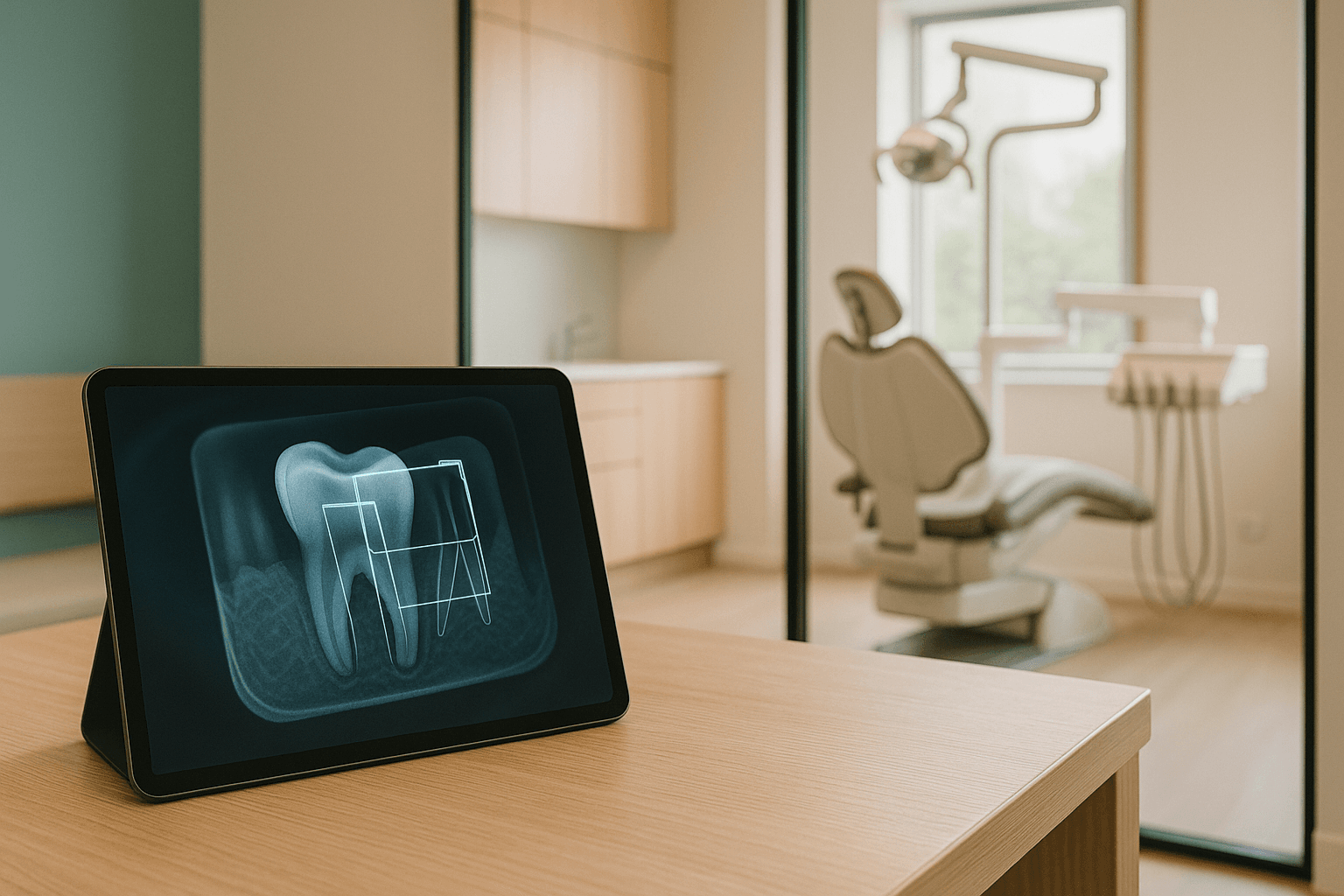
AI radiograph analysis in dentistry is the use of computer vision models — typically convolutional neural networks or transformer-based architectures — to automatically detect caries, bone loss, calculus, furcation involvement, restorations, and periapical lesions in dental X-rays. The AI overlays findings on the image for the clinician to confirm or dismiss, functioning as a second set of eyes rather than a diagnostic replacement.
How accurate is AI radiograph detection?
Modern AI radiograph detection models achieve 85% to 95% sensitivity on interproximal caries detection in peer-reviewed studies, comparable to or exceeding experienced dentists on the same images. Specificity (avoiding false positives) ranges from 82% to 92% depending on the condition and dataset. Performance drops on edge cases: very small lesions under 1 mm, severe artifacts, and unusual anatomy, which is why human verification remains mandatory.
Does AI replace the dentist in reading X-rays?
AI does not replace the dentist in reading X-rays. Current regulatory and clinical standards treat AI radiograph analysis as an assistive tool — the licensed dentist remains the diagnosing provider and must confirm or reject every AI-flagged finding. The benefit is consistency: AI catches subtle lesions missed under fatigue or time pressure, while the dentist contextualizes findings against medical history, patient symptoms, and clinical examination.
What conditions can AI detect on dental radiographs?
AI can detect interproximal caries, occlusal caries, periapical radiolucencies, bone loss severity, furcation involvement, existing restorations and crowns, calculus deposits, impacted teeth, and supernumeraries. Some systems also measure bone levels in millimeters for periodontal charting and flag root fractures. The breadth of detectable findings varies by vendor, with best-in-class systems covering 15 to 25 distinct conditions.
How does AI radiograph analysis affect treatment planning?
AI radiograph analysis affects treatment planning by surfacing early-stage pathology that would otherwise be deferred to monitoring, by standardizing the bone-loss staging that drives periodontal treatment, and by reducing the rate of missed diagnoses across an operatory. Practices typically see a 15% to 25% increase in treatment acceptance because patients can visually see the AI-annotated findings alongside the dentist's explanation.
Is AI radiograph analysis HIPAA compliant?
AI radiograph analysis is HIPAA compliant when the vendor provides a Business Associate Agreement (BAA), encrypts data in transit and at rest, and either processes images in an appropriately secured environment or performs all inference locally without sending patient data to third parties. Practices should verify where images are processed, whether they are retained for model training, and whether the vendor's BAA specifically covers image data.
How Computer Vision Reads a Radiograph
Computer vision models do not "see" a radiograph the way a dentist does. They process the pixel grid through learned filters that detect edges, textures, and shapes, then pass those features through dozens of layers until the final layer outputs per-pixel probabilities for each condition.
Architecture Basics — CNNs and Transformers
The two dominant architectures for dental imaging AI are convolutional neural networks (CNNs), pioneered for visual tasks in the 2010s, and vision transformers (ViTs), which became competitive around 2021. CNNs are still widely used because they are fast and battle-tested. Transformers are newer and perform better on complex scenes with many overlapping structures.
A typical caries-detection pipeline combines both: a CNN backbone for feature extraction and a transformer head for contextual reasoning. This hybrid approach is what powers most of the high-accuracy systems shipping in 2025 and 2026.
Training Data — The Hidden Variable
The quality of an AI radiograph model is almost entirely determined by the quality and size of its training dataset. A model trained on 100,000 well-labeled radiographs from diverse populations vastly outperforms one trained on 1 million images from a single clinic, because the diverse model has learned to generalize across anatomy, imaging devices, and patient demographics.
Best-in-class models in 2026 are trained on 2 to 10 million radiographs with consensus labels from 3 or more board-certified dentists per image. Smaller vendors train on tens of thousands, which shows up as higher false-positive rates in day-to-day use. The infrastructure powering these models matters as much as the architecture itself — our breakdown of AWS Bedrock for clinical dental AI explains how foundation models are fine-tuned and deployed within HIPAA-compliant environments.
Output — Segmentation Maps, Not Just Boxes
Modern systems produce pixel-level segmentation masks, not just bounding boxes. That means the AI does not just say "caries present" — it highlights the exact pixels it believes represent the lesion, with a confidence value. This granularity is what lets the dentist quickly validate or dismiss each finding without re-reading the entire image.
What the Evidence Actually Shows
AI radiograph analysis sits at a different credibility level from many other dental AI claims because the evidence base is substantial and peer-reviewed.
Published AI Radiograph Performance Benchmarks
Numbers are approximate aggregates from multiple 2023-2025 peer-reviewed studies. Individual vendor performance varies. What is consistent across studies is that AI augmentation reduces missed findings compared to solo reads while keeping specificity competitive.
How AI Radiograph Analysis Fits Into the Operatory Workflow
The best implementations are nearly invisible. The dentist captures the radiograph as usual, and within 2 to 6 seconds an overlay appears with highlighted findings. The dentist reviews each annotation, accepts or rejects, and proceeds with the consultation.
Step-by-Step Integration
Step 1 — Image capture (unchanged)
The assistant captures the bitewings, panorex, or FMX using the existing sensor and software. Nothing about the capture workflow changes.
Step 2 — AI inference (automatic)
The image is routed to the AI service — either local or cloud depending on vendor. Inference completes in 2 to 6 seconds. The radiograph appears in the imaging software with overlays already applied.
Step 3 — Dentist review and confirmation
The clinician scans the overlay, accepts valid findings, dismisses false positives, and may flag findings for further imaging or biopsy. Most reviews take under a minute once the team is trained.
Step 4 — Patient consultation with visual
The annotated radiograph becomes a consultation tool. Patients understand "early decay between these two teeth" much better when they can see the highlighted lesion than when it is verbally described.
Step 5 — Chart entry and audit trail
Confirmed findings flow into the chart with a notation that the AI flagged them and the dentist confirmed. When paired with dental NLP, these findings can be automatically coded and structured for billing and clinical decision support. Dismissed findings are logged separately for future audit and model improvement.
Vendor Capability Comparison
The dental AI radiograph market in 2026 has a handful of mature vendors and many new entrants. Evaluating them requires looking past marketing claims to the actual technical and compliance details.
| Capability | Baseline Vendor | Best-in-Class |
|---|---|---|
| Conditions detected | 6-10 | 20-25+ |
| Sensitivity (caries) | 80-85% | 91-95% |
| Processing location | 3rd-party cloud | In-practice or HIPAA BAA cloud |
| Training data use | Retained, used in model | Opt-out, not retained |
| FDA clearance | Varies | 510(k) cleared where required |
| PMS integration | Basic image overlay | Deep integration, chart automation |
| Processing time | 8-15 seconds | 2-6 seconds |
The Evidence-Based Case for Adoption
Several studies have quantified the impact of AI augmentation on real-world practice metrics. The direction is consistent across studies: more findings caught, more consistent staging, and higher patient understanding without sacrificing diagnostic specificity.
A 2024 multicenter study across 27 US practices tracked 18,000 patient encounters before and after AI augmentation. Missed caries dropped 22%, periodontal staging consistency across providers improved 38%, and treatment acceptance rose 18%. The economic value of those combined effects was estimated at $110 per patient encounter on average. Similar gains are showing up in adjacent diagnostic domains — our deep dive on AI periodontal screening covers how algorithms detect gum disease from probing depths, attachment loss, and radiographic bone changes before clinical signs become obvious.
Crucially, false-positive rates did not spike. The dentists in the study dismissed AI-flagged findings they disagreed with at appropriate rates, and the study found no evidence of over-treatment.
Privacy, Security, and the Regulatory Picture
AI radiograph analysis has become a focal point for HIPAA scrutiny because radiographs are protected health information. Practices considering adoption should verify three things before signing any vendor contract.
1. Where is the image processed?
In-practice (on-premise) or in a HIPAA-compliant cloud with a BAA. Avoid vendors that cannot name the specific data center or country where inference runs.
2. What happens to the image after inference?
Is it deleted, retained, or used to train future models? Practices have been surprised to discover their patients' radiographs were powering commercial model releases sold to competitors.
3. FDA regulatory status
Some dental AI tools are FDA 510(k) cleared as medical devices. Others operate as decision-support tools outside FDA jurisdiction. Both can be compliant, but the distinction affects liability and insurance considerations.
Related Reading from NexV
If this article is useful, you will want to read our deeper dive on AI treatment planning in dentistry. Radiograph analysis is one input into the broader treatment-planning workflow, and the full picture matters.
Concerned about where your patient imaging data lives? Our dental AI data privacy piece explains exactly where radiographs flow when practices use cloud-based AI tools, and how to evaluate vendors on this.
Looking to improve workflow beyond diagnostics? Ambient AI scribe covers the clinical documentation side of the same trend — AI that listens during the exam and drafts chart notes in real time.
Want to understand the text side of dental AI? Our guide to natural language processing in dentistry explains how NLP converts clinical notes into structured, codeable data — the complement to what computer vision does with radiographs.
Frequently Asked Questions
Do I need to switch imaging software to use AI radiograph analysis?
How much does AI radiograph analysis cost for a small practice?
Can AI radiograph tools read cone-beam CT (CBCT) scans?
Is patient consent required to run AI on their radiograph?
What happens when the AI disagrees with the dentist?
The Future — From Assistive to Autonomous?
The trajectory for AI radiograph analysis is not toward autonomous diagnosis. Regulatory bodies in the US, EU, and UK have been clear that a licensed clinician must remain in the loop for any diagnostic decision that affects treatment.
What is advancing is the breadth and subtlety of what AI can detect. Next-generation models are being trained on longitudinal radiograph series, meaning they can detect lesions that are progressing across visits rather than catching only the current state. That capability alone will change how early-stage caries are managed in routine care.
If you want to see what evidence-based AI radiograph analysis looks like inside a modern clinical platform, book a NexV demo. We can walk through how the AI integrates into a live operatory and how the data privacy architecture keeps patient imaging exactly where it belongs.