AI Implant Planning in Dentistry: How CBCT Models and Bedrock-Backed Agents Are Changing Surgical Workflows
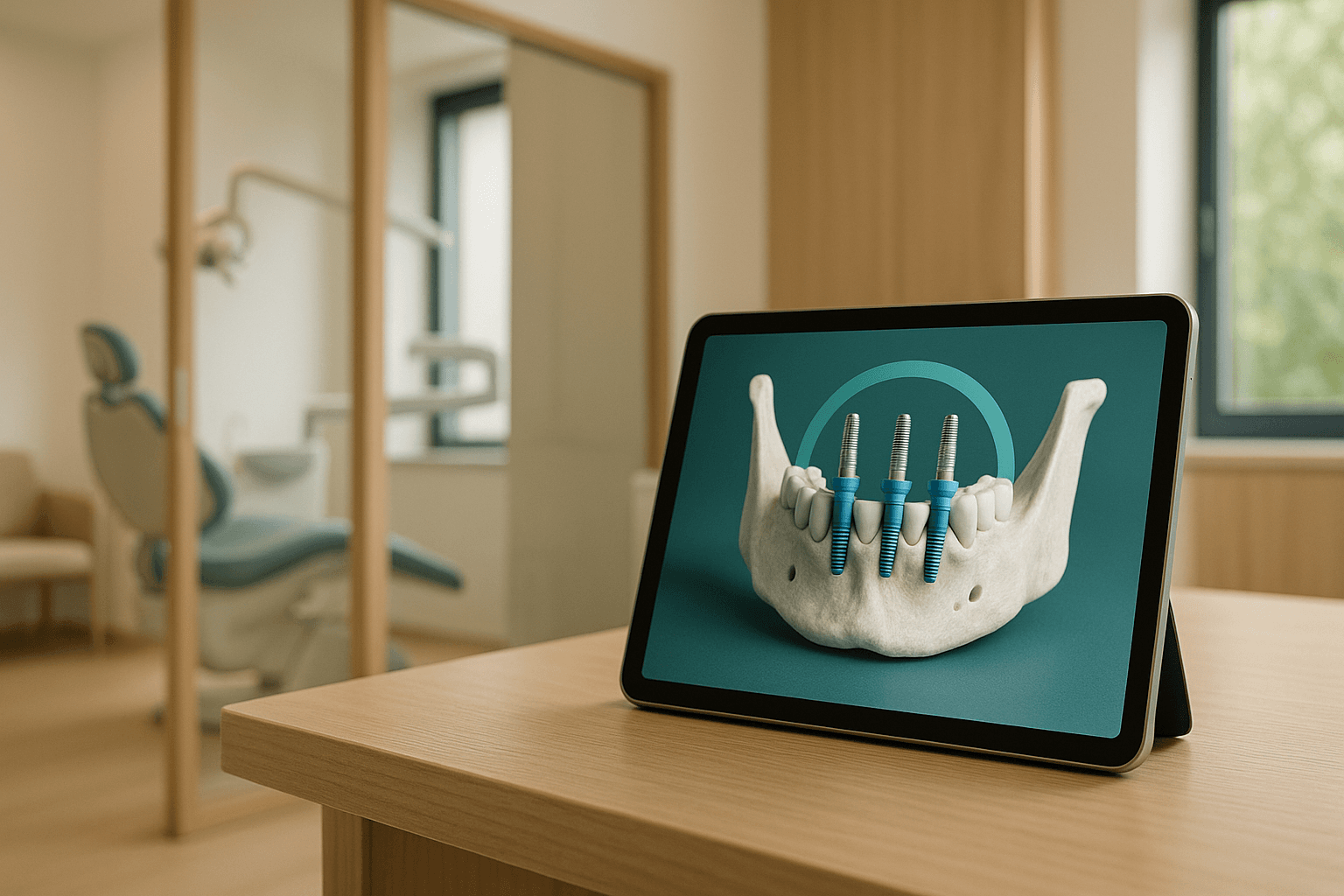
Walk into any production-grade general practice in 2026 and look at where the revenue actually concentrates. Implants — the single procedure where a $2,800 to $5,400 case fee meets a 90-minute chair block and a CBCT scan that nobody on staff is fully trained to interpret.
That is the gap AI implant planning is filling. Not the demo-reel version with a glossy 3D rendering — the version that lives behind a HIPAA boundary, runs on Bedrock, and writes a surgical guide file that the lab actually mills.
Why CBCT Planning Was the Bottleneck No One Wanted to Name
Cone-beam computed tomography has been the standard of care for implant planning since roughly 2014. The problem was never the imaging — it was the 35 to 60 minutes of clinician time required to segment the scan, measure bone density, identify anatomical landmarks, and translate all of that into a guided surgery file.
Most general dentists do not do this work themselves. They send the DICOM out to a third-party planning service, wait two to five business days, and pay $150 to $400 per case for a guide that arrives with someone else's name on the planning report.
That outsourcing pattern is exactly the kind of operational friction that AI is now collapsing. Similar to what we covered in our breakdown of AI radiograph analysis workflows, the unlock is not better imaging — it is removing the human-in-the-loop step that was never clinically necessary.
How AI-Assisted CBCT Segmentation Actually Works
The core technical pipeline has three stages, and understanding each one matters because the failure modes live at the boundaries between them. Skip the boundary, miss the failure mode.
| Stage | What Runs | Typical Latency | Failure Mode |
|---|---|---|---|
| Volumetric segmentation | 3D U-Net or nnU-Net variant on the DICOM | 20-90 seconds | Misidentifies the IAN canal in cases with dense cortical bone |
| Anatomical reasoning | Bedrock-hosted Claude or a fine-tuned medical LLM | 8-15 seconds | Hallucinated landmark when the segmentation confidence is low |
| Guide-file generation | STL writer + tool registry call to the lab API | 30-60 seconds | Schema drift between planning system and lab CAM software |
Why Bedrock-Backed Agents Are the Right Substrate for This Workload
Clinical AI workloads have a non-negotiable constraint that consumer AI does not — the data cannot leave a HIPAA-eligible boundary, and the model traffic has to be loggable to CloudTrail for audit. That eliminates most of the obvious model-hosting options before the architecture conversation even starts.
Amazon Bedrock with a signed BAA is the path of least resistance because the inference traffic stays inside the customer's VPC, the model invocations get logged to CloudTrail by default, and KMS-encrypted PHI never touches a public endpoint. We covered the broader compliance shape in HIPAA-grade clinical AI for dental practices, and the same constraints apply here.
The agent layer matters because implant planning is not a single-shot inference. It is a coordinated sequence — segment, reason about anatomy, check against the patient's medication list for bisphosphonate exposure, validate against the lab's CAM tolerances, write the guide file. Five tool calls, five places where idempotency keys and a retry policy save you from a re-scanned patient.
The Chairside Workflow That Actually Ships
Where Practices Are Capturing the Margin
The case-acceptance number is the one most operators underweight. When a patient walks out of a consult with a scheduled surgery date instead of a "we'll call you next week," the close rate moves materially — and that compounds across an implant book of business.
Our deeper breakdown of the unit economics lives in the dental AI ROI analysis, but the short version is that implant planning has the cleanest payback period of any clinical-AI use case we have measured.
The Failure Modes Nobody Demos
Vendor demos do not show you the cases where the segmentation model misidentified the inferior alveolar nerve in a patient with dense cortical bone. They do not show you the schema drift between the planning system and the lab's CAM software when the lab silently updates their STL parser.
These are the production failure modes that determine whether AI implant planning is a real workflow or a quarterly liability. Run any new planning model in shadow mode for 60 to 90 days against your existing planning service before you cut over.
How AI Implant Planning Connects to the Rest of the Practice Stack
Implant planning does not live in isolation. The same agent infrastructure that segments a CBCT also has to verify the patient's insurance benefits, confirm the implant code is covered, and flag any prior authorization requirements before the surgery date is booked.
That is the integration point most practices underestimate. We covered the upstream side in our piece on AI insurance verification workflows, and the downstream charting and documentation side in AI dental charting.
The pattern that holds across all of these — implant planning, insurance verification, charting, periodontal screening — is that the AI is not a feature bolted onto the practice management system. It is a parallel agent layer that reads from and writes to the existing PMS through a tool registry, with every action logged for audit.
What to Look for in a Vendor Conversation
Most of the vendors selling AI implant planning in 2026 are demoing on cherry-picked CBCT scans with clean anatomy and standard bone density. The conversation gets useful when you ask three specific questions about production behavior.
First — what is the segmentation accuracy on your bottom-decile cases, defined as patients with dense cortical bone, prior bone grafts, or significant sinus pneumatization? Second — what is the model-version pinning policy, and how is a new model version validated before it touches production scans? Third — show me the CloudTrail logs from a recent case and walk me through what is loggable and what is not.
If the vendor cannot answer those three questions with specifics, they are not running production-grade clinical AI — they are running a demo with a sales motion attached.
Frequently Asked Questions About AI Implant Planning
What CBCT scanners are compatible with AI implant planning?
Any scanner that produces a standards-compliant DICOM volume — Carestream, Planmeca, Vatech, Sirona, i-CAT, and Acteon are the common ones. The AI layer reads DICOM, not vendor-specific formats, so scanner brand is rarely the constraint.
How is the AI planning system validated for clinical use?
Shadow-mode validation against an existing human-planned baseline for 50 to 100 cases, scored on nerve-canal proximity, angulation deviation, and lab-side fit. That validation report is what you produce in an audit; without it, you cannot defend the workflow.
Can AI implant planning be used for full-arch and All-on-X cases?
Single-tooth and short-span cases are the strongest validated use cases as of 2026. Full-arch planning is moving from research to clinical, but most production-grade vendors still flag full-arch for additional clinician review rather than autonomous plan generation.
What happens if the AI proposes an unsafe plan?
The clinician review step is where unsafe plans get caught. The agent surfaces confidence scores on each anatomical structure and flags low-confidence segmentations for explicit human review before any guide file is generated.
How does this fit with our existing practice management system?
Through a tool registry — the planning agent reads patient demographics and medical history from the PMS through a defined API, writes the completed plan and guide file back to the patient record, and logs every read and write to CloudTrail. The PMS does not need to be replaced.
What is the implementation timeline for a multi-location DSO?
Realistic timeline is 90 to 120 days from kickoff to first production case at the pilot location, including the shadow-mode validation period. Rollout to additional locations after the pilot validates is typically 30 to 45 days per location.
Where This Goes Next
The frontier in 2026 is not better segmentation — that problem is largely solved at the accuracy level the clinical workflow needs. The frontier is the orchestration layer that connects implant planning to the rest of the patient journey, from initial consult through the post-surgical follow-up that closes the case.
Practices that treat AI implant planning as a point solution will capture the planning-fee savings and stop there. Practices that treat it as one workflow inside a coordinated agent layer — alongside caries detection, periodontal screening, and Bedrock-backed clinical AI infrastructure — will capture the operating margin that comes from running the practice as a system.
If you are scoping your first AI implant planning workflow and want a second set of eyes on the architecture, the team at NexV builds and operates HIPAA-grade clinical AI across CBCT, charting, and verification environments every week. Reach out for a working session — we will map your current planning workflow, name the failure modes you are about to hit, and leave you with a deployable plan and a shadow-mode validation protocol.